Showing posts with label Money. Show all posts

Monday, April 19, 2021

Lucio Tan Admitted To Hospital Due To COVID-19


Business tycoon Lucio Tan was hospitalized after contracting COVID-19, his daughter confirmed on Saturday.

In an Instagram post, Vivienne Tan thanked everyone who prayed for his father’s swift recovery.

“He is in stable condition, responding well, and recovering,” she said.

Vivienne also asked for some privacy at this time.

“Please continue to pray for his speedy recovery. Thank you,” she wrote.

Lucio Tan, 86, is the chairman of MacroAsia and LT Group.

He also owns Philippine Airlines and Philippine National Bank.

Wednesday, April 7, 2021

COVID-19 patients in tents, isolation and swab tests - President Duterte Tells Philhealth To Cover


Malacañang said on Tuesday that President Rodrigo Duterte has ordered the Philippine Health Insurance Corporation or Philhealth to shoulder COVID-19 patients in tents, isolation, and even their swab tests.

“Nagbigay ng direktiba po ang ating Presidente sa Philippine Health Insurance Corp. na kasama sa health insurance coverage ang RT PCR tests, isolation sa accredited community isolation units at hospitalization para sa mild at critical cases ng COVID-19,” Presidential Spokesperson Harry Roque said in a briefing.

“Kaugnay nito, kung ang tents ay kasama sa in-patient care, kailangan covered ito sa kasalukuyang in-patient COVID-19 package,” he added.

In a hearing at the House of Representatives, a lawmaker exposed that some patients pay hospitals for Php1,000 per hour even though they were only admitted in tents.

PhilHealth said in a statement that it has noted the current situation where patients are temporarily placed in tents because hospitals can no longer admit them in regular hospital beds.

Some medical facilities are allegedly charging a P1,000 per hour rate for patients in tents. Philhealth said that they will investigate these claims.


“Be it COVID-19 or not, patients should be afforded with all the financial help as guaranteed by the Universal Health Care Law,” the statement read.

The statement was made after some COVID-19 patients and their relatives complained that they have to pay their hospital bills since being admitted in tents is not covered by Philhealth.

PhilHealth said it “has been reviewing existing policies to better respond to the extraordinary demands brought about by this pandemic.”

“Enhanced guidelines will be issued the soonest to ensure that adequate financial protection is duly provided to the patients without compromising the quality of care,” the agency added.

Monday, March 15, 2021

Christmas Eve, New Year’s Eve no longer holidays in PH this 2021

Filipinos should expect fewer non-working days this year as three dates that have long been traditional holidays are now “special working days” in order to help the economy recover from the impact of the COVID-19 pandemic.

President Rodrigo Duterte has signed a proclamation reducing the number of holidays this 2021..

In Proclamation 1107, the President made the following days as “special working days.”
• Nov. 2, 2021 – All Souls’ Day
• Dec. 24, 2021 – Christmas Eve
• Dec. 31 – New Year’s Eve

The three dates were previously special non-working holidays.

“For the country to recover from the adverse economic impact of the COVID-19 pandemic, there is a need to encourage economic productivity by, among others, minimizing work disruption and commemorating some special holidays as special (working) days instead,” Duterte said.

Duterte previously lamented that the Philippines is losing Php2 billion a day due to the restrictions imposed against COVID-19.

“According to the Secretary of Finance, araw araw ngayon hanggang matapos ‘tong COVID, araw araw we are losing P2 billion na pera para sana ‘yun sa mga tao,” Duterte said in a speech on Monday night.


Duterte said that the Filipinos could’ve started earning money but the economy itself prohibits them to do so.

“The workers, the Filipino workers would have earned that money kung ang ekonomiya natin gumagalaw,” he added.

The National Economic and Development Authority said that Filipinos lost Php1.4 trillion in 2020 due to quarantines.

“Lahat ng bayan ngayon ng buong mundo, bagsak. Talagang bagsak. Tayo, maganda na sana. No’ng hindi dumating ‘yung COVID we were doing fine. Hindi naman very good. We were doing good. Tapos dumating ‘yung COVID. Walang kita,” Duterte said.

The Philippines also recorded a -9.5% gross domestic product in 2020 — the worst economic statistic recorded in the history of the Philippines since 1947.

Monday, March 8, 2021

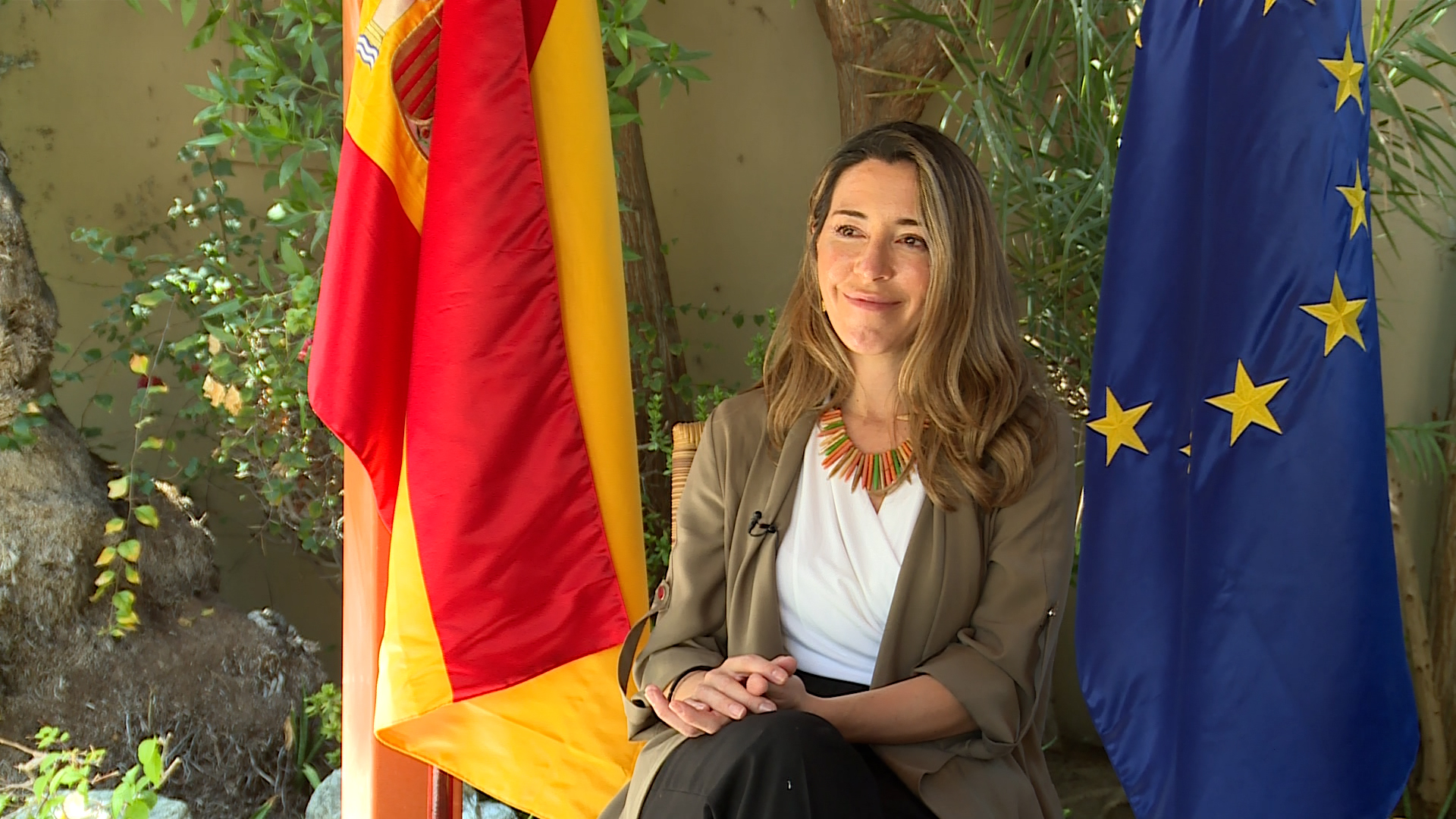
Spain wants to increase current AED26.8+ bn FDI in UAE: Spanish minister


Photo credit: WAM

The United Arab Emirates’ Foreign Direct Investment (FDI) in Spain has reached over €6 billion (AED26.8+), according to a senior Spanish official.

In an exclusive interview with Emirates News Agency (WAM), Xiana Méndez, Spanish Minister of State for Trade, also said Spanish FDI in the UAE is valued at around €3 billion (AED13.2+ bn).

The UAE’s investments in strategic sectors in Spain, such as renewable energy, mines and other industries are “impressive,” she added in an interview in Abu Dhabi during her first official visit to the UAE this week.

“I think that we can do more and better and also diversify the scope of the sectors receiving these investments [into Spain],” the Spanish minister emphasized.

“There is a lot that we can do in order to boost the Spanish investment here in Emirates. Even though these figures [€3 billion] are impressive and important, especially because they have increased in recent years; still we can do more. There’s a scope for improvement.”

Spanish investments in the UAE are mostly concentrated in some sectors related to agro-industry, she said.

The minister revealed that Spain has initiated talks on a bilateral investment protection agreement with the UAE and once it is concluded, it will further enhance the investment flow between both countries.

“I think there’s a lot of interest from both sides in having this institutional framework to boost foreign direct investment in both directions,” she explained.

A recent Reuters report quoting the Spanish Foreign Minister, Arancha González Laya, said Spain is in talks with sovereign wealth funds from several Gulf countries to co-invest in projects financed by European aid in order to leverage the initial investment. Spain is also seeking to increase Spanish companies’ investment in the Gulf countries, particularly in infrastructure development.

Asked about the report, Méndez said Spain’s plan of increased investments in the UAE’s infrastructure sector will have preference in sustainable mobility, renewable energy, water and waste treatment.

On the investments from the Gulf, she said even without the European aid, Spain is a very attractive destination for foreign direct investment. “Sovereign funds know that and that’s why they have been presenting huge projects to Spain during the last decade. But it is true that with the arrival of these European funds, we will have the chance to identify new projects that will transform our productive sector.”

In Abu Dhabi, she visited the International Defence Exhibition and the Naval Defence Exhibition (IDEX and NAVDEX) 2021. Many Spanish companies have been participating in IDEX for many years and “I was impressed by the quality of the products and services presented [at the event],” Méndez said.

In Dubai, the minister visited Gulfood 2021, a global event with the participation of 2,500 companies from 85 countries, including some of the most prominent brands in the food and beverage sector.

With the presence of 50 Spanish companies, the event is a great opportunity to enhance bilateral cooperation in the food sector, she said.

Saturday, March 6, 2021

Filipino, Proud United Arab Emirates Residents

The burgeoning population of overseas Filipino workers (OFWs) in the UAE can be attributed to the safety of the country, according to a straw poll conducted by the Filipino Times—following the release of the results of the National Happiness and Wellbeing Survey. The year-long study of the Ministry of Community Development shows that 93 percent of residents said they are ‘proud to live in the UAE’ and 8 out of 10 residents said ‘they are living a meaningful life’ in the emirates. In terms of safety,  92 percent of the 10,000 respondents aged 15 and above said they feel safe walking alone at night.

Her Excellency Hessa Essa Buhumaid, Minister for Community Development and Chairwoman of the Wellbeing Council, said that the positive response of the residents in the latest National Happiness and Wellbeing Survey reflect the UAE’s vision in spearheading initiatives that contribute to the general welfare of everyone living in the country.

“These development ideas enhance the UAE’s pioneering aspirations to achieve the best wellbeing standards through qualitative projects and initiatives launched by the national task forces, bringing together various government authorities to make great efforts in promoting people’s wellbeing, especially in the exceptional circumstances surrounding the population this year,” said Buhumaid.

Philippine Consul General in Dubai Paul Raymund Cortes said that apart from securing the well-being and safety of all those who wish to come to the UAE, the host government has also been very strategic in terms of identifying networks and policies that would enable migrants of different professions to search for economic opportunities for them in this country.

“The reputation of the UAE as a safe haven for migrants who wish to fulfill their ambitions and reach for their goals is grounded on the host government’s warm welcome to the over 9 million expats in the country,” he said.

“The UAE has also been reputed to be a hotbed of innovation which allows business and entrepreneurial acumen to develop and further grow in this country, which will in turn allow more expats to come to the UAE to enjoy these innovations and developments and be an active contributor towards these goals as well,” he added.

Welcome to the safest country

Filipinos in the UAE salute Abu Dhabi after it was named the world’s safest city for the fifth consecutive year; it is joined by Sharjah and Dubai in the top 10 list compiled by the crowdsourced data website Numbeo. These rankings are beyond just numbers; to a great extent, they foretell not only a city’s or nation’s success, but also the residents’ future. This was shown by the National Happiness and Wellbeing Survey, wherein 84 percent of the UAE population is found to be generally optimistic in life.

The Philippine Consul General added that Filipinos, along with 200 other nationalities, become determined to play an equal role in this country’s development due to the security they provide.

“When people do not feel uncomfortable with the security provided—meaning that they have strong faith in the host government and their policy towards building a safe and stable society—people become more focused on building economic opportunities and strengthening techniques and expertise that would make the lives of everyone easier, more efficient, more effective, and more attuned to helping more people,” he said.

Fair treatment 

When Anabelle Fernandez first arrived in the UAE 15 years ago, she was filled with hope and optimism that this would be her key to helping her family as the new breadwinner.

The UAE did not disappoint her. Fernandez now treats the country as her second home as she fell in love with how the UAE society treats everyone fairly without looking at someone’s country of origin, line of work, etc.

“In UAE they treat all people equally – walang mahirap o mayaman. Ever since pa naman (way back 15 years ago), napakaganda na mamuhay dito sa UAE. All you just have to do is obey and follow the rules. And life is very convenient; you can reach out for help from authorities anywhere you are,” said Fernandez.

Haven for breadwinners

Perlita Malupeng, who has been working for over two decades as a household worker in the country, also told TFT her inspiring story and gratitude for the UAE.

“Malaki na ang naitulong sa akin ng UAE sa pamamalagi ko dito – unang una na doon ay napagtapos ko sa pag-aaral ang aking anak hanggang kolehiyo. Nagkaroon na din ako ng pampundar para makabili ng sariling bahay at lupa. Bukod dito, natulungan ko din makapunta at makapagtrabaho ang aking dalawang kapatid,” said Malupeng.

Meanwhile, Robbie Tirol, a hotel staff working for nearly 10 years in Abu Dhabi, said the UAE helped him transform his dreams into reality.

“Sa nine years ko po dito sa UAE, unti-unti pong natutupad ang aking mga pangarap. Nakabili po ako ng lupa at nakapag pundar din ako ng sarili kong bahay. Patuloy ko ding nasusuportahan ang aking pamilya financially sa pagpapadala sa kanila buwan-buwan. Syempre, marami na rin akong napuntahan at nakapag-tour na rin ako sa iba’t ibang bansa mula nung dumating ako dito sa UAE,” said Tirol.

Stamp of Safety

OFW Marissa Albano said that since she began working here in 1992, she has enjoyed the pleasures of feeling safe no matter where she goes at any time of the day – a testament to the UAE’s commitment to safety.

“I think we Filipinos find happiness in UAE from the high standard of security, and police patrolling anytime of the day. We can walk freely, we can do our shopping anytime without worries. Everything about this country is full of surprises and worth living for!” said Albano.

Blessed to be here

Overseas Filipinos living in the country express their gratefulness for the UAE’s leadership, whose vision is to ensure that everyone feels the convenience and safety that will make most expatriates treat it as their second home.

“Saludo po ako sa mga pinuno ng UAE at taos pusong nagpapasalamat sa lahat ng kanilang pagsasa-ayos ng mga batas at pagpapatupad na naaayon sa kapakanan ng lahat. Dito sa UAE, panatag ka na kakampi mo ang batas ‘pag nasa tama ka,” said Malupeng.

They also underscored the importance of free COVID-19 vaccination, which is being provided by the UAE government for everyone, on an optional basis.

“Maraming salamat sa mga pinuno ng UAE at during this pandemic binigay niyo without cost yung vaccine laban sa COVID-19 at mga treatments para mabigyan nang pangalawang buhay ang ibang taong nawalan na nang pag-asang mabuhay. Patuloy niyo pong pinaparamdam sa amin na mas mahalaga ang buhay nang tao at salamat sa pagmamahal niyo sa amin,” said Fernandez.

United Arab Emirates National Agenda For Next 50 Years

UAE leaders approve creation of revitalized National Agenda for the next 50 years

The brainstorming retreat of the UAE government has resulted in the approval of a revitalized National Agenda, which will serve as the country’s framework for the next half-century.

The new set of national agenda will be based on the concept of balance development. With its details yet to be released, the framework will steer the country to a new direction and generate new strategic projects, which are aimed at boosting the competitiveness of vital sectors and sustaining economic stability within the next 50 years.

Most of these new initiatives will be anchored on digital transformation.

The two-day retreat, chaired by His Highness Sheikh Mohammed bin Rashid Al Maktoum, Vice President and Prime Minister of UAE and Ruler of Dubai, and His Highness Sheikh Mohamed bin Zayed Al Nahyan, Crown Prince of Abu Dhabi and Deputy Supreme Commander of the UAE Armed Forces, brought together ministers, government officials and dignitaries to lay out a strategic framework for the development vision for the country’s next phase.

The Vice President noted, “Over the past 50 years, we started from the desert of our land to the desert of Mars. Our dreams will be even bigger for the next 50 years.”

His Highness lauded the huge participation of H.H. Sheikh Mohamed bin Zayed in the brainstorming retreat. “H.H. Sheikh Mohamed bin Zayed’s participation in the retreat lays out a new and clear 50-year vision for the UAE,” the Vice President said.

For his part, H.H. Sheikh Mohamed bin Zayed stressed that the UAE government has the necessary capabilities, talents, and resources to draw the roadmap for the next 50 years.

“Our government teams in the next phase will only welcome people who will exert 10 times more efforts and energy to achieve greater successes. Our vision is to make the UAE an attractive destination for talents, ideas, and investment,” the Abu Dhabi Crown Prince said.

His Highness added, “We will preserve H.H. Sheikh Mohammed bin Rashid’s principle of always being number one. Our aim is to compete internationally.”

Thursday, January 28, 2021

Over 70,000 Expats Affected: Kuwait Cancels Residency Permits For Foreign Workers Aged Over 60

More than 70,000 expatriates will be forced to leave Kuwait, as its government implemented a decision to ban residency permits of foreign workers aged 60.


The new legislation was implemented last January 1, according to the Kuwaiti Public Authority.


It also includes expats who only finished high school.

This move was imposed to redress the increasing imbalance between the population of citizens and expatriates.

Those who fall under these two category will have to leave after the expiry of their residency by the end of 2021.

The decision includes expatriates who work in professional sectors such as construction, car repair and restaurants, according to Xinhua news.

Among those who will be affected by the decision is 62-year-old Filipina Lynn.


Lynn has been working in the Gulf state for 15 years.

With the expiry of her residency visa this February, she will be left with no choice but to go back to the Philippines for good.

At present expat workers account for around 3.4 million of the country’s 4.8 million people.

Saturday, July 25, 2020

Face Covers Up: Should You Wash Them Or Throw Them Away?


Face coverings are now obligatory in shops in England.

The step brings England according to Scotland, that made face coverings compulsory in shops on 10 July as well as follows the British government complied with in the steps of other countries on 11 May by recommending the wearing of masks when in encased spaces, such as mosting likely to the supermarket.


From 15 June, it also ended up being mandatory to use a face covering when using public transport.

" If you can, use a face covering in an encased area where social distancing isn't feasible as well as where you will enter call with individuals you do not usually meet," the suggestions stated. "This is most pertinent for brief periods indoors in crowded locations, as an example, on public transportation or in some stores.

" Proof suggests that putting on a face covering does not secure you. Nonetheless, if you are infected yet have not yet created signs and symptoms, it might supply some defense for others you enter into close call with."

The government has actually made use of the term "face covering", rather than "mask", since it's eager to keen to compare the former as well as "the surgical masks or respirators made use of by healthcare and also other employees as component of individual protective devices. These must continue to be booked for those that require them to shield against risks in their workplace."

The standards recommend making your very own face treatments in your home rather. However what do you require to do to make sure whatever face covering you're utilizing is risk-free and also efficient?

How do you wear a face covering "correctly"?

The federal government advice states you ought to use face treatments "effectively". The crucial element is to make certain that whatever you're using is completely covering your nose and also mouth while enabling you to breathe easily, and to wash your hands prior to placing it on or taking it off.

Prevent touching your eyes, nose, or mouth in any way times, and also do not touch the front of the face covering, or the component of the face covering that has touched with your mouth and also nose. When eliminated, ensure you cleanse any surfaces the face treatment has touched.

The guidelines also specify that face coverings need to not be utilized by children under the age of two or those who might locate it challenging to "manage them correctly"; for instance, key institution age youngsters who are unassisted, or those who already have breathing conditions.

What do I do with a disposable mask?

A non reusable mask is just designed to be made use of as soon as, not multiple times-- do not be attracted to reuse it. You must utilize this kind of mask when prior to tossing it away, and need to also dispose of it if it ends up being at all wet, according to the World Wellness Organisation (THAT).

Before placing one on, wash your hands first as well as examine whether there are any type of holes or tears in the mask when you eliminate it from its product packaging. Many disposable masks have a top and a bottom-- the top is the side that has a stiff, flexible edge, designed to mold around your nose.

There's also a front and a back to the majority of disposable masks: the coloured side is normally the front and should encounter far from you. When connecting the mask, either by connections or loops that walk around your ears, make certain there is no gap between the mask and your face by pressing the flexible top piece so it's formed around your nose.

Try not to touch the mask while using it, as well as if you do, clean your hands or make use of hand sanitiser after that. When eliminating the mask, attempt not to touch the front of it-- make use of the ties rather. Toss it in a shut bin and, you presumed it, wash your hands.

What do I do with a recyclable mask or face covering?

If you have any kind of sort of multiple-use mask or face treatment, using it is just half the fight-- you additionally have to wash it.

Recommendations differs on how typically you ought to do this. While Gulf News creates, "Your face mask ought to be cleaned at least once a day. We can not stress this enough," the UK federal government suggestions just mentions you ought to clean it "routinely". On The Other Hand, Kate Grusich, a speaker for Centers for Condition Control and also Avoidance (CDC), says that the frequency with which you wash a face covering must hinge on exactly how frequently you use it.

" If you're just taking the periodic journey to the pharmacy as well as supermarket, a regular clean must be suitable, as long as the mask isn't visibly dirtied," she told GQ. "If it is soiled, or if you have actually been around someone with verified or thought Covid-19, the face covering must be washed promptly after use."


What do I do with a disposable mask?
A disposable mask is only designed to be used once, not multiple times – don’t be tempted to reuse it. You should use this kind of mask once before throwing it away, and should also dispose of it if it becomes at all damp, according to the World Health Organisation (WHO).
Before putting one on, wash your hands first and check whether there are any holes or tears in the mask when you remove it from its packaging. Most disposable masks have a top and a bottom – the top is the side that has a stiff, bendable edge, designed to mould around your nose.
There’s also a front and a back to most disposable masks: the coloured side is usually the front and should face away from you. When attaching the mask, either by ties or loops that go around your ears, ensure there is no gap between the mask and your face by pushing the bendable top piece so it’s shaped around your nose.
Try not to touch the mask while wearing it, and if you do, wash your hands or use hand sanitiser afterwards. When removing the mask, try not to touch the front of it – use the ties instead. Throw it in a closed bin and, you guessed it, wash your hands.
What do I do with a reusable mask or face covering?

If you have any kind of reusable mask or face covering, wearing it is only half the battle – you also have to wash it.

Advice differs on how often you should do this. While Gulf News writes, “Your face mask should be washed at least once a day. We cannot stress this enough,” the UK government advice simply states you should wash it “regularly”. Meanwhile, Kate Grusich, a spokesperson for Centers for Disease Control and Prevention (CDC), says that the frequency with which you wash a face covering should be dependent on how often you wear it.

“If you’re just taking the occasional trip to the pharmacy and supermarket, a weekly wash should be appropriate, as long as the mask isn’t visibly soiled,“ she told GQ. ”If it is soiled, or if you’ve been around someone with confirmed or suspected Covid-19, the face covering should be washed immediately after use.“

When you’ve removed your face covering, the government advises storing it in a plastic bag until you have an opportunity to wash it, and washing your hands after use. The covering can go in with other laundry, using your normal detergent. But what temperature to wash it at? According to the CDC, you should use “the warmest appropriate water setting and dry items completely”. A hot wash is recommended, so 60 degrees or higher.

What can I use as a face covering?

If you don’t have an actual mask, the government guidelines state that “it can be as simple as a scarf or bandana that ties behind the head”.

However, they have also shared ways on making your own face covering out of a T-shirt or squares of cotton fabric. Others have demonstrated how you can turn a sock into a face mask using just a few simple cuts. See our guide to making your own face mask here.

According to a study by researchers from the University of Chicago and the Argonne National Laboratory in Illinois, the most effective material for face coverings is a sheet of tightly woven cotton plus two sheets of chiffon, made from polyester and spandex. This combination was found to filter out 80 to 99 per cent of particles, depending on their size.

The team suggested this combination was on a par with N95 masks, used by medical professionals. Tightly woven cotton with natural silk or flannel also worked well.

But if you don’t have access to a variety of materials, plain cotton works well as a face covering material, offering breathability and some filtration.


Sharing is caring...


Read more

Saturday, May 30, 2020

What Is SIM Card Swapping? 5 Tips to Protect Yourself From This Scam

Your SIM card’s number is a gateway for relentless criminals. With something as simple as a string of digits, hackers can swiftly deplete your bank account.

Do you want to know the scariest part? Cybercriminals don’t even need to steal your phone to gain access to your number and personal information. This recent trend in hacking has become known as SIM card swapping.

Let’s take a closer look at what SIM card swapping is, and how you can avoid it.
How Does a SIM Card Work?

Before we dive into the nitty-gritty of the SIM swapping fraud, you’ll need to know how a SIM card works. Do you remember when you purchased your last phone? You might’ve noticed that one of your carrier’s representatives swapped your SIM card from your old phone to your new one.


Believe it or not, that tiny chip in your phone stores all of your essential account information. When its 20-digit ICCID number falls into the hands of a skilled criminal, you’re in trouble.
Advertisement

What Is the SIM Card Swapping Scam?

SIM card swapping involves a lot of trickery and deception. Hackers contact your service providers and hope to speak with an especially trusting employee. They’ll impersonate you to get what they want: your SIM card data.

If their scam is successful, your SIM card data will transfer to the criminal’s SIM card. No, they aren’t interested in your text messages or phone calls from your friends; they’re focused on receiving two-factor authentication (2FA) messages from accounts that hold your valuable information.

Most banks require 2FA when you sign in to your online account. But instead of you inputting the one-time password (OTP) received through SMS, the hacker does.

Tips to Protect Yourself From SIM Card Swapping

While there’s not much you can do once a hacker gets hold of your SIM card information, there are still methods you can use to prevent it from happening. Here are some of the most effective ways to halt hackers:
Advertisement

1. Change Your 2FA Method

Receiving your 2FA through text messages is convenient and all, but it can only make your situation worse when you’re a victim of SIM card swapping.

Opting to use an authenticator app like Authy or Google Authenticator associates your OTP with your actual phone, rather than your phone number. Simply connect the app to your most important accounts and you’ll receive your security codes through the app instead. 

Set Up a PIN with Your Mobile Carrier

Adding a PIN to your account makes it harder for a hacker to gain access to it. A SIM swapper will have to provide your secret PIN or passcode when trying to make changes to your account, and that’s why it’s so important to have one.

Fortunately, you can add a PIN to your account by visiting your carrier’s website.

If you’re a customer at Verizon, you’re required to have a PIN. To edit or add a PIN to your account, sign in to your account Verizon’s PIN management page. After you determine your PIN, re-type it, then hit Submit.

To create a PIN on T-Mobile, sign in to your My T-Mobile account. You’ll have to pick a verification method and hit Select. Once this is complete, enter your PIN code, and click Next to confirm.

With AT&T, you can add a passcode to your account by signing in, and going to your Profile. Under Wireless passcode, hit Manage extra security. Clicking the checkbox will require you to provide a passcode when making major changes.

You can add a PIN from the Sprint website by signing in to your account, and selecting My Sprint. Click Profile and security, then locate the Security information section. Simply add or edit your PIN, and hit Save.

3. Separate Your Phone Number From Your Accounts

Have you ever used your phone as a way to change your password? When hackers steal your SIM card data, they can too.

Once hackers have locked you out of your own accounts, they’ll gather as much information as they can. Criminals won’t hesitate to take money out of your bank account, or even worse, sell your personal information on the dark web.

Deleting your phone number from your most important online accounts can save you the headache of worrying about a SIM card swap. If you’re required to have a phone number associated with your account, get a VoIP number with Google Voice instead.  

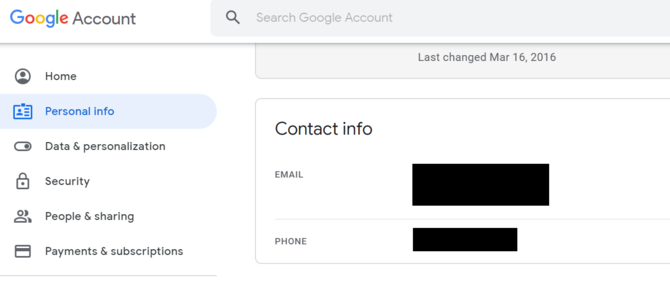
To delete your phone number from Google, sign in to the Google Account page and head to the Personal Info section. If you see your phone number, make sure to delete it.


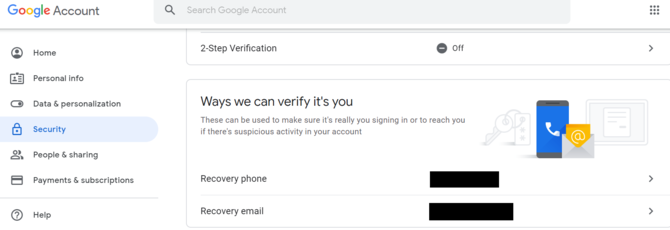
In the Security section, scroll down, and remove your phone number from the Ways we can verify it’s you option.


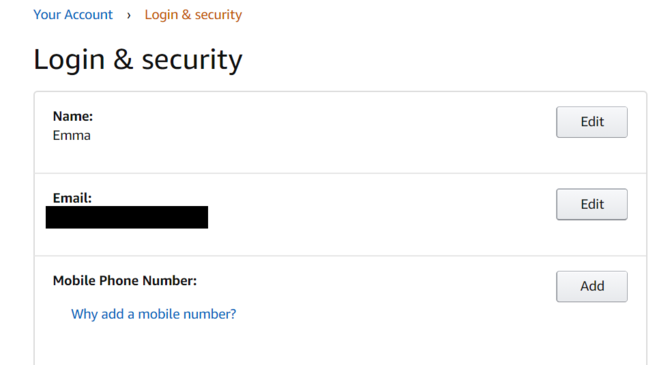
For Amazon, click Your Account, and then navigate to Login & Security. Erase your phone number or add a VoIP number from there.


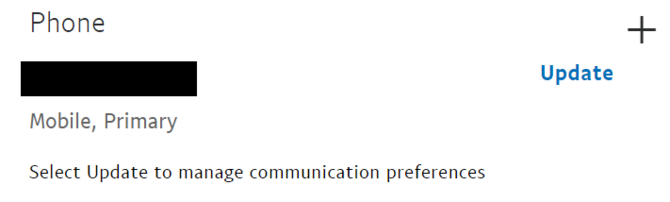
You can also erase your phone number from PayPal by clicking the gear icon in the corner of the web page. Under the Phone section, choose to change your number.


You should also erase your phone number on major social media sites, online retailers, and especially your online banking account.

4. Use Encrypted Messaging

SMS doesn’t support encryption, which means that hackers can easily spy on your messages and steal your 2FA codes. Using an encrypted messaging app such as iMessage, Signal, or WhatsApp can prevent nosy hackers.

5. Beware of Phishing Scams

You should always delete sketchy emails that ask for your personal information. Banks and other institutions will never request confidential information via email. These types of emails are always a result of a hacker trying to steal your information.

Are You a Victim of SIM Swapping?

Many victims don’t realize they’ve been SIM swapped until it’s too late. The biggest warning sign of the fraud is a loss of cell reception.

Some banks and mobile carriers have security measures that prevent SIM card swapping from happening in the first place. Your carrier may let you know if your SIM card has been re-issued, while banks will usually send you an alert if it detects unusual activity on your account.

Having your mobile number attached to your accounts makes signing in simple. However, you can’t always count on your phone number staying safe forever. SIM card swapping poses too much of a threat to guarantee your privacy.

Be on the lookout for phishing emails, as answering those malicious inquiries can make a hacker’s job easy. Don’t know what a phishing email looks like? You can find more information in our article on how to spot a phishing email.


Image Credit: VitalikRadko/Depositphotos

How to Spot a Phishing Email

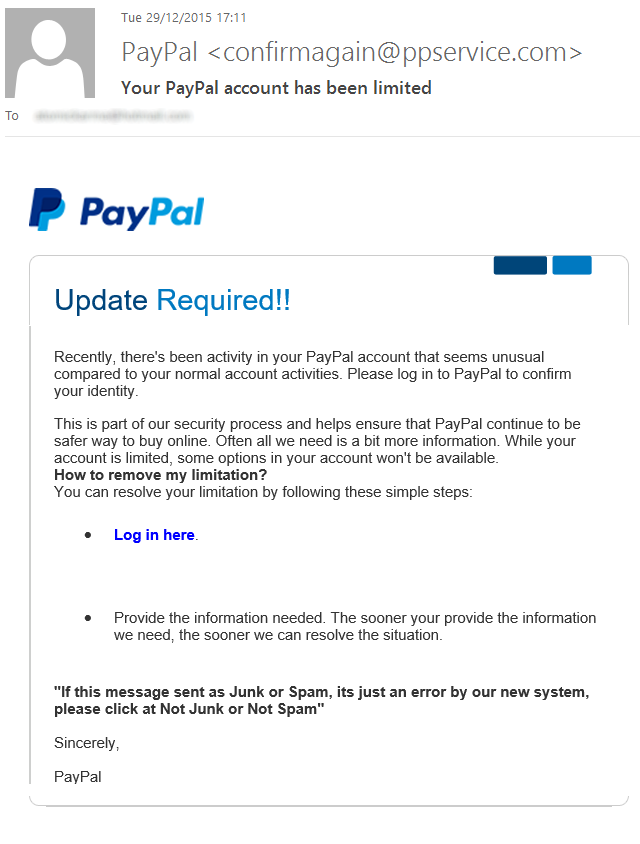
The email drops into your mailbox. It’s from PayPal, informing you that due to some unauthorized use of your account, it has been locked. “Damn hackers,” you think, “trying to guess my password again!”

You need to click the link in the email to re-enable your account and set a new password… but stop right there. The email you’re reading is a very well-crafted phishing email, designed to scam you. The information it contains is false: your account is not locked or restricted.

Phishing emails are becoming increasingly sophisticated, so what can we do to spot one and avoid being scammed?
Spotting a Phishing Email is Tough

While it’s not impossible to spot a phishing email (a message purporting to be from a legitimate company, designed to con you into divulging personal information) for most people – 80%, according to a new survey by CBS News and Intel Security – it’s pretty difficult. It’s not all bad news though; while I managed 90% in the survey, which you can still take online, a previous Intel survey revealed 94% of information security professionals were tricked by a phishing email at least once.

Being duped by phishing emails means more than just enabling someone to harvest your details. These scammers might glean enough information to be able to steal your identity (available for pennies on the Dark web), use it to borrow money in your name, and leave you with some financial headaches. Meanwhile, that cash is used for illicit purposes, funding illegal industries such as the drugs trade, human trafficking and child pornography. There has even been suggestion in the past few years that terror groups are generating funds by converging their interests with organized crime. Here's How Much Your Identity Could Be Worth on the Dark WebIt's uncomfortable to think of yourself as a commodity, but all of your personal details, from name and address to bank account details, are worth something to online criminals. How much are you worth?

Allowing yourself to be conned and letting the banks and credit card companies clean up the mess is not the answer. At the very least, it is an incredible risk to take, one that can be avoided by educating yourself about how to spot a phishing email.

Some Example Phishing Emails

It’s not possible to share every single example of a phishing email, but the chances are you’ll get one of these over the next few months. Even if you don’t, we can use these examples to demonstrate the continually improving sophistication of these messages. These days, it can be tough to spot a phishing email simply because they look so convincing.

PayPal


This is a very convincing phishing email targeting PayPal accounts. While phishing messages in the past might have been littered with links, this one just has the single “Log in here.” Style and subtlety clearly win out here, and there is little indicating that it is fake. However, three clues tell us it is a fake:
Advertisement

We have a spelling mistake: “its just an error…” which you can see in the bold type towards the end.
The sender’s address, “confirmagain@ppservice.com” – this is clearly not PayPal.
PayPal will not send you an email with a login link.
Apple – Or Is it a Bank?


This is a very polished phishing email, seemingly from Apple, asking the recipient to check some unread messages. But if you get fooled by this email, you’ve a long way to go:
Sender is listed as “drowley@midwestbank.com” – is this from Apple, or a bank?
Hovering the mouse over the “Read Now >” link reveals a link that is clearly not the Apple website (nor that of a bank).
The App Store doesn’t store or route messages.
WhatsApp with this Email?


With this email, the presentation is reasonable, but the brevity of content – that there is a WhatsApp message to play – is enough to convince the recipient to click Play to find out who is trying to get in touch. As with the other messages, however, there are clues here:

The sender email, “dajohns@mixom.com”, has clearly nothing to do with WhatsApp. Arguably, it might be misconstrued by the recipient as being the sender of the voicemail message, but in this case, if it’s an unknown email address, you’d be advised to avoid it.
“Whats App” is displayed as two words at the top of the message, and as one word in the footer.
I don’t have a WhatsApp account.

In each of the three examples above, there is enough information, if you look closely enough, to determine that the message is bogus. If you receive these or anything else that you have doubts about, you should mark them as junk.

Tools You Can Use to Block Phishing Emails

If you’re still not 100% confident (and you shouldn’t be, as this is a tough game to play), take advantage of the various tools at your disposal that can help with the detection and blocking of phishing emails.

For instance, if you’re using Microsoft’s Outlook email service from www.outlook.com, you’ll have a built in spam email detector, which is designed to pick up phishing emails. This works well about 95% of the time, with occasional phishing attempts making it into your inbox. If you spot these, you should mark them as “junk” to help Microsoft prevent them being picked up by other users. You should also take the time to confirm that you’re not spamming your friends with dangerous emails thanks to malware installed on your PC. Hotmail Is Dead! Microsoft Outlook Email Services Explained Stop searching for Hotmail! Microsoft Outlook email services are confusing. Here are Outlook web app, Outlook Online, and others explained.

Similarly, Google’s Gmail service will also detect and divert spam and phishing emails to the junk folder, leaving you free to carry on with your email reading without criminal distraction.

Meanwhile, premium online security suites, such as Bitdefender 2016, include tools to protect you from phishing attempts. Rather than protect you at the email inbox level, these tools tend to focus on your browser, and prevent you from visiting fraudulent websites or entering information in them. 

Do you know how to spot a phishing email? Have you been caught out in the past? Tell us about it in the comments box below.


Affiliate Disclosure: By buying the products we recommend, you help keep the site alive. Read more.

It Doesn’t Matter If You’re Not On Facebook: They’re Still Tracking You

A new report claims the social networking service is tracking people without their permission. It doesn’t matter if you don’t even use Facebook: they’re still watching you. Here’s what that means to you, and what you can do about it.
Advertisement

Of course, Facebook’s privacy settings have been a worry since the site was set up in 2004, and frequent changes to your settings means there’s often a fresh new concern. But we do throw ourselves online with such enthusiasm! Photos, private messages, locations – many of us document our lives using Facebook and Twitter. 

And when Facebook acquired WhatsApp, even the privacy of that SMS service got a few sweating.

And to add further fuel to controversies, the Belgium Privacy Protection Commission (CPVP/CBPL) says Facebook “tramples” on European privacy laws…

What Are They Doing?


Following a report by their inter-university centre, EMSOC/SPION, in conjunction with their counterparts in France, Spain, the Netherlands, and Germany, the commission states:
Advertisement

“The research results are disconcerting. Facebook disregards European and Belgian privacy legislation in several ways… [Tracking people through social plug-ins] does not only impact Facebook users but also virtually every Internet user in Belgium and Europe.”

The social networking giant has seemingly ignored EU law by tracking traffic on Facebook.com domains – fan pages, most notably, but also profiles with looser privacy settings – that don’t require an account. Perhaps more worryingly, the social plug-in used to “Like” pages across more than 13 million websites reads tracking cookies and sends that data onto Facebook.

So it actually doesn’t matter if you’ve got a Facebook account or not: they can still track you.

And if you do have a Facebook account, session cookies allow the service to track sites you visit even after logging out.

EU privacy law asserts that consent has to be given before using tracking cookies (though exemptions apply if cookies are necessary to connect to a service or if they’re needed to deliver something the user has requested). It’s basically the reason websites have to let first-time visitors from the EU know that they employ cookies.
Advertisement

How Are They Getting Away With It?


A spokesman from Facebook said:

“As we expressed to the CBPL in person when we met, there is nothing more important to us than the privacy of our users and we work hard to make sure people have control over what they share and with whom. Facebook is already regulated in Europe and complies with European data protection law, so the applicability of the CBPL’s efforts are unclear. But we will of course review the recommendations when we receive them with our European regulator, the Irish Data Protection Commissioner.”

And that’s the crux of Facebook’s argument: that they’re only subject to Irish law, as their European headquarters (a lavish, typically-cool building designed by Frank Gehry, complete with ping-pong table, inspirational posters, and giant illustrations of astronauts) is in Dublin.

The idea of shadow profiles – information about people who don’t use the service – isn’t anything new, of course. Max Schrems, Austrian activist and founder of Europe v Facebook, previously spoke out about Facebook flouting European law, and said in 2011:

“Now we are rather positive that the Irish authorities will make Facebook change a whole lot. If you read the interviews with the authority it seems like they are taking the cause very seriously.”

The Privacy Protection Commission doesn’t have the power to impose fines, but can begin lawsuit procedures.

Article 29 is Also Kicking up a Fuss


The Belgium Privacy Protection Commission isn’t the only agency concerned about tracking cookies. The Article 29 Working Party, an independent data regulator, says social plug-ins should also ask permission from the user before sending out cookies, and that session cookies should expire when logged out of Facebook.

You can opt out of tracking used for advertisements by the social network, but Brendan Van Alsenoy, who contributes to the European Law Blog, told The Guardian:
Advertisement

“Facebook cannot rely on users’ inaction (ie not opting out through a third-party website) to infer consent. As far as non-users are concerned, Facebook really has no legal basis whatsoever to justify its current tracking practices.”

Last month, Facebook admitted to tracking non-users, but said it was due to a bug that is being fixed.
What Can You Do About It?


As Facebook says, you can opt-out of personalised ads which can publicise your likes, or you could even use non-tracking browser extensions like Disconnect (though these can sometimes be a pain when leaving comments, for example). Otherwise, some extensions like Edit This Cookie for Chrome let you customise which cookies you allow.

It’s very easy to get frustrated with the social network, and the European Commission (EU) has a recommendation if you are concerned about your privacy. In a hearing (instigated by Max Schrems) concerning the Safe Harbour framework, which allows the transmission of personal data from Europe to the USA, EU Legal Advisor.

“You might consider closing your Facebook account, if you have one.”

If you think this might be a step too far, you could try a trial deactivation. But if you’re too sceptical about what Facebook does with your data, you can indeed properly close your account. This Is What Facebook Does with Your Data & How To Opt Out [Weekly Facebook Tips]Facebook is a publicly traded company. As such, its success isn't just measured in traffic or users, but first and foremost in revenue. In other words, Facebook is pressured to make more money.

Have you ever considered leaving Facebook? Why? Or have you already left the network – and, in retrospect, do you think this was a good move? Let us know below.

Image Credits: Spy vs Spy by Tony Fischer; Cookie Monster by Surian Soosay; and Self Snitch by Poster Boy.

Thursday, April 23, 2020

Most Popular Smartphone Brand in the Philippines

Group study breaks down the most searched-for mobile phone brands in the country.


What’s the most popular smartphone brand in the Philippines? Most people would probably answer Samsung and Apple only because their ads are just so ubiquitous and they’ve had such a chokehold on the market for years.

But as the results of an independent study will tell us, the real answer may come as a surprise.

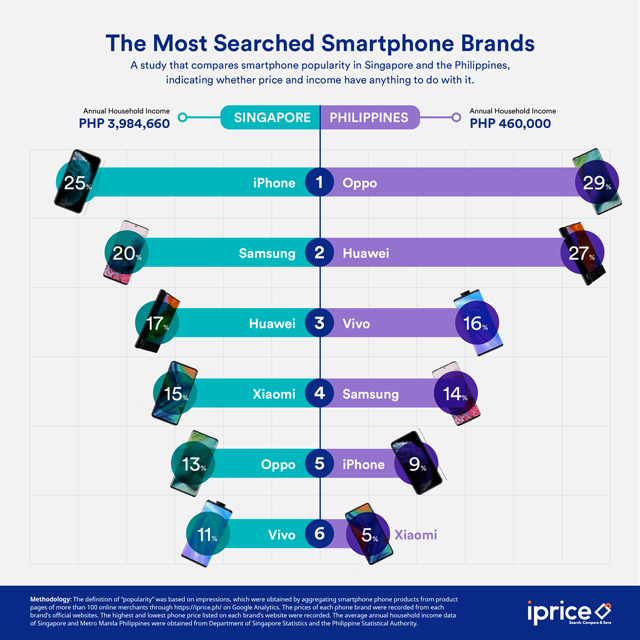
Meta search website iPrice analyzed the most popular smartphone brands in the Philippines based on searches on its platform and compared it with the results in Singapore. The logic to this, according to iPrice, is to find out whether spending power has something to do with what smartphones people are searching for, considering how Singapore has a much higher household income compared to the Philippines.

According to the Philippine Statistics Authority, the average annual household income in Metro Manila is P460,000, the highest in the country. Singapore, meanwhile, has an average annual household income of P3,984,660, according to that country’s Department of Statistics.

The iPrice Group picked the brands based on a report by Counterpoint Research on the global market share in 2019 and added Cherry Mobile and MyPhone for the Philippines. The study also recorded each brand’s highest and lowest priced smartphones from their official websites/marketplace.

Here are five key insights from the study:

1. Mid-tier smartphone brand Oppo is the most popular brand in the Philippines

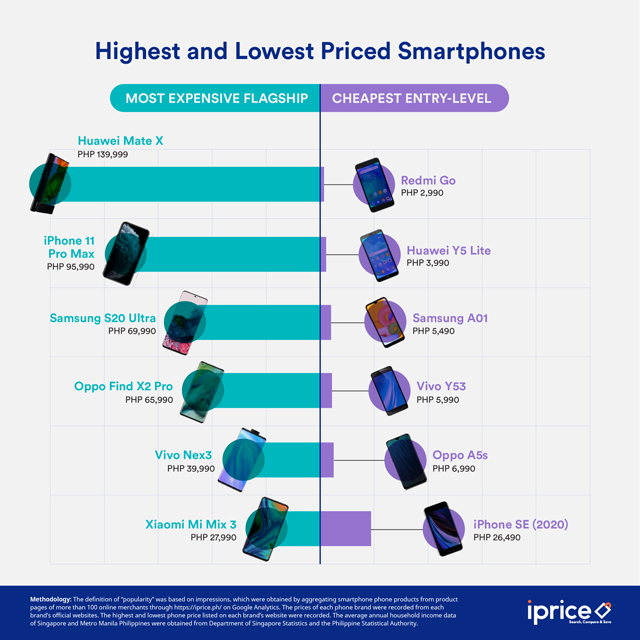
Oppo is the most searched for smartphone in iPrice’s Philippine platform despite the fact that it is not the cheapest brand. Its newest flagship model, the Find X2 Pro, is worth as much as P65,990, which, iPrice notes, is only P4,000 less than Samsung’s flagship Galaxy S20 Ultra.

Meanwhile, Oppo’s entry-level model, the A5s, is priced at P6,990. Certainly affordable but still not the cheapest smartphone available in the market.
PHOTO BY IPRICE GROUP.

2. The most popular brands in Singapore are also some of the most expensive

Considering Singaporean’s high average annual income, it shouldn’t come as a surprise that Apple’s iPhone is the most-searched smartphone brand there. Samsung—whose flagship model also isn’t exactly cheap—is a close second. 

3. Huawei’s wide price range makes it popular in both Singapore and the Philippines

Priced at P139,999, Huawei’s Mate X is one of the most expensive smartphones currently available in the market. However, Huawei also offers the Y5 Lite, which, at P3,990 is also one of the cheapest smartphones you can get. (Only Xiaomi’s Redmi Go is cheaper at P2,990). According to iPrice, Huawei’s wide range of expensive and affordable phones, makes it one of the most popular brands in both the Philippines and Singapore.
PHOTO BY IPRICE GROUP.
4. Big Brands Samsung and iPhone aren’t as widely searched for in the Philippines

There was a time when the competition for smartphones was practically a two-way fight between Samsung and Apple. Those days are long gone. Today, although the two brands are still popular in the Philippines, they have since been replaced by mid-tier brands like Oppo and Vivo as the most searched-for smartphones in the country. Again, iPrice surmises that it’s likely because not all Filipinos are able to afford the flagship models of these brands, so they look for more affordable models.

5. Xiaomi is becoming a rising new competitor

Interestingly, more people are searching for Chinese brand Xiaomi on the iPrice platform than Vivo and Oppo in Singapore. Although the company’s international headquarters is in Singapore, iPrice says awareness there could be attributed to more than just that fact.

Manwhile, in the Philippines, Xiaomi has gained some ground against local brands like Cherry Mobile and MyPhone, which once dominated the market for cheaper smartphones.

In the IPrice group study, the definition of “popularity” was based on impressions from 2019 to 2020, which were obtained by aggregating smartphone phone products from product pages of more than 100 online merchants through https://iprice.ph on Google Analytics. The prices of each phone brand were recorded from each brand’s official websites/marketplace. The highest and lowest phone price listed on each brand’s website were recorded.

Share...

Wednesday, March 18, 2020

This Proprietor Sent An Unforeseen Coronavirus Message To His Renter Are Overwhelmed

At a time when people across the world are bothered with maintaining their work-- much less concerning exactly how they will manage to pay rent-- one proprietor tipped up.


iStock

Hull-born Amy Gledhill tweeted on Tuesday, "My proprietor simply text me this and I'm sobbing. PROPRIETORS, BEAR IN MIND. If you remain in a placement to state this to someone, please do. When we can't count on the federal government, we have actually got to assist each other."

The message read, "provided whatever that seems to be happening with Covid 19 ... I desire you to really feel safe and secure in your home ... We're residing in insane times so care for yourself and your household."

Some reacted with pleased disbelief stating, "Most proprietors would not do this, what a beautiful gentlemen he is," and also "Chris Landlord is a bloody good person. Be like Chris Proprietor."

Others were still generally not impressed with the housing circumstance, commenting points like: "Mine is still evicting me in 3 months ..." and also "As well as my property owner has just offered us a 2 month notice."

This all follows Work leader Jeremy Corbyn required proprietors to provide rental fee settlement vacations to tenants over the weekend break in action to the coronavirus. He additionally required a stop in expulsions.

Various other lessees have not been so fortunate. One Twitter user claimed that he was being forced out after losing his task in the middle of the break out:

There have been telephone calls across social media in Britain for a #rentfreeze, thinking about the alarming nature of the wellness crisis where lots of people will be either given up, or unable to participate in work.

Share...